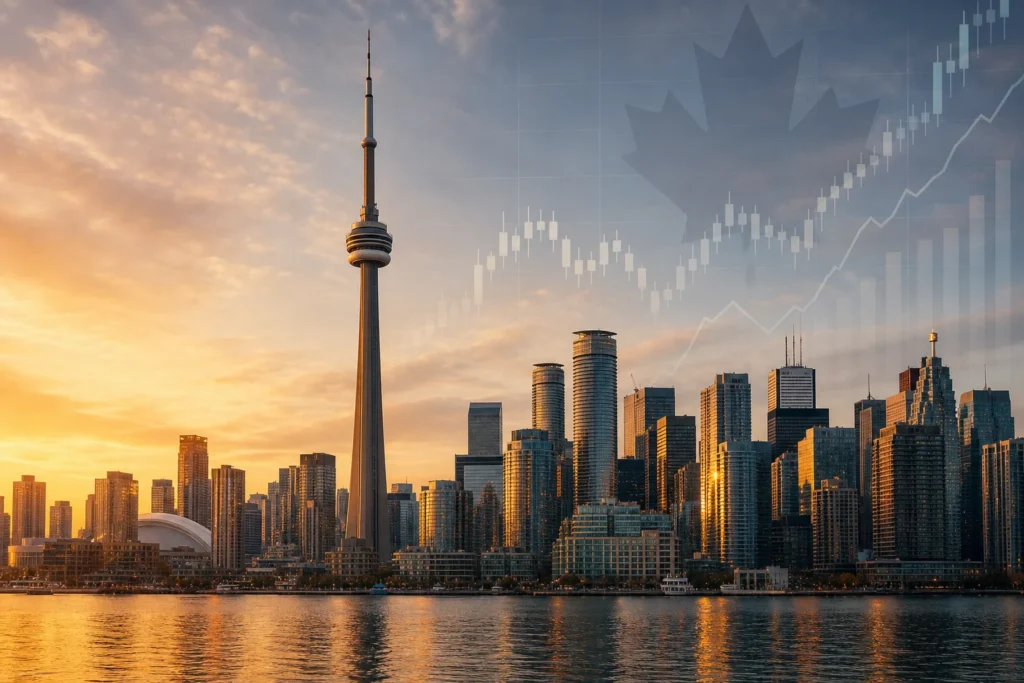
TSX market trends Canada in 2026 reflect a mix of steady monetary policy, returning inflation pressure, commodity volatility, and selective strength in financials, energy infrastructure, and global tech names held by Canadian investors.

This guide outlines the main TSX market trends Canada themes for 2026 – what is driving the Toronto Stock Exchange, which sectors Canadian investors are rotating into, and how macro data from the Bank of Canada fits the picture.
Related guides: Bank of Canada rate outlook, Enbridge stock Canada, NVIDIA stock Canada, Canadian dividend ETFs for TFSA, and best HISA Canada.
TSX Market Trends Canada: Overview for 2026
The Toronto Stock Exchange (TSX) remains the home market for most Canadian portfolios. In 2026, TSX market trends Canada discussions usually centre on three layers:
- Macro: inflation, BoC policy, and CAD moves
- Sectors: banks, pipelines, producers, telecoms, and selective growth
- Global spillover: U.S. rates, oil prices, and mega-cap tech held in TFSAs and RRSPs
Canadian investors in Ontario, Quebec, Alberta, and British Columbia often experience the same national index – but local housing costs, wages, and sector employment still shape how households react to market moves.
Exchange and market structure: TMX Group – TSX.
Macro Drivers Behind TSX Market Trends in 2026
Bank of Canada and interest rates
After a long easing cycle, the BoC held the policy rate steady in early 2026 while inflation ticked higher. Rate stability supports bank margins and dividend stocks, but keeps pressure on highly leveraged growth names.
Deep dive: Bank of Canada rate outlook and inflation Canada.
Official releases: Bank of Canada – Monetary Policy Report.
Inflation and the Canadian dollar
Inflation Canada returned above the 2% comfort zone in parts of 2026, partly linked to energy. A softer or stronger Canadian dollar (CAD) affects importers, tourists, and investors who hold U.S. stocks in registered accounts.
Data: Statistics Canada – Prices and price indexes.
Trade and North American growth
Canada’s open economy means TSX sentiment often tracks U.S. manufacturing, consumer spending, and trade policy headlines. Investors watch whether export-oriented names benefit or face margin pressure.
Sector Rotation on the TSX in 2026
Sector rotation means shifting portfolio weight from one industry to another as the cycle changes. On the TSX in 2026, common rotation themes include:
- financials when rates are stable and credit quality holds
- energy infrastructure when income investors want yield with contract-backed cash flow
- producers when oil prices spike – see Canadian oil stocks
- global tech when AI capex narratives dominate – see NVIDIA stock Canada
Rotation does not require constant trading. Many Canadians use Canadian ETFs to maintain diversification while tilting slightly toward favoured sectors.
Commodities and Energy Trends
Canada is a major commodity exporter. TSX market trends Canada in 2026 often follow:
- crude oil and natural gas prices
- pipeline and utility regulation
- Alberta production outlook and carbon policy debates
Integrated producers and pipeline companies do not move in lockstep. For infrastructure and dividends, investors study Enbridge stock Canada; for commodity beta, they compare producers on the TSX.
Financials, Dividends, and Defensive TSX Themes
The Big Six banks and large insurers remain core TSX weights. When recession fears rise, Canadians often debate whether bank stocks are cheap or early warnings on credit losses.
Income investors pair banks with:
- telecom and utility names
- pipeline stocks
- Canadian dividend ETFs for TFSA
Stock-level example: TD Bank stock Canada.
Tech, AI, and Global Holdings in Canadian Portfolios
Although the TSX is bank- and resource-heavy, Canadian investors increasingly hold U.S. mega-cap tech in TFSAs and RRSPs. AI infrastructure spending kept names like NVIDIA in headlines through 2026.
That creates a split personality in many portfolios:
- domestic dividend and TSX index exposure
- global growth via U.S. listings (with FX and withholding considerations)
Balancing both is a common market trends 2026 conversation in Toronto and Vancouver investing communities.
Earnings Season: What to Watch on the TSX
Earnings season – when companies report quarterly results – can reset sector narratives quickly. For TSX trends in 2026, watch:
- bank net interest margins and loan loss provisions
- energy company capex and shareholder returns
- pipeline distributable cash flow and dividend guidance
- telecom capital spending and pricing
- guidance language on Canada and U.S. consumer demand
Investors who do not follow every report often rely on ETFs or a short list of core holdings, then adjust after major surprises.
Regional Angle: Toronto, Montreal, Vancouver
National TSX market trends Canada data hides regional realities:
- Toronto / GTA: large financial and real estate workforce; housing costs shape how much households invest each month.
- Montreal / Quebec: aerospace, tech, and energy research interest; bilingual media coverage of BoC and TSX moves.
- Vancouver / BC: housing sensitivity, commodity links, and cross-border economic ties.
- Calgary / Alberta: energy employment and dividend culture tied to resource stocks.
Cost-of-living context: Toronto salaries and Montreal cost of living.
What Canadian Investors Can Do (Without Chasing Headlines)
- Match risk to goals – retirement, home down payment, or long-term wealth.
- Use registered accounts (TFSA, RRSP, FHSA where eligible) for tax-efficient growth – RRSP vs TFSA.
- Prefer diversification via ETFs if single-stock risk feels high.
- Keep cash for emergencies in competitive products – best HISA Canada.
- Rebalance once or twice a year instead of reacting to every headline.
Investing basics: FCAC – investing basics.
TSX Sector Themes at a Glance (2026)
| Sector | Trend theme | Investor focus |
|---|---|---|
| Financials | Stable rates, dividend culture | Credit quality, payouts |
| Energy / pipelines | Oil volatility, infrastructure yield | Cash flow, regulation |
| Tech (global) | AI capex cycle | Valuation, concentration risk |
| Dividend ETFs | Income in TFSA/RRSP | Fees, sector weights |
FAQ: TSX Market Trends Canada
What are the main TSX market trends Canada in 2026?
Investors are watching BoC policy, inflation, sector rotation between financials and energy, and global tech exposure in Canadian portfolios – especially dividends, pipelines, and AI-related U.S. holdings.
Is the TSX only banks and oil?
Financials and energy are large index weights, but the TSX also includes telecoms, railways, REITs, and growth names. Many Canadians add U.S. stocks and ETFs for broader sector exposure.
How do Bank of Canada rates affect the TSX?
Rates influence bank earnings, mortgage demand, discount rates for stocks, and bond competition for dividend yields. See our BoC outlook guide.
Should I buy individual TSX stocks or ETFs?
ETFs reduce single-company risk; individual stocks allow targeted views on names like Enbridge or TD. Many investors combine both in registered accounts.
Does a recession in Canada mean the TSX will fall?
Equity markets can weaken in recessions, but timing is uncertain. Diversification, time horizon, and cash reserves matter more than headline predictions.
Is this investment advice?
No. This article summarizes TSX market trends Canada for educational purposes. Consult licensed professionals before making investment decisions.
Disclaimer: All investing involves risk, including loss of principal. Market trends can change quickly. This content is not a recommendation to buy or sell any security.