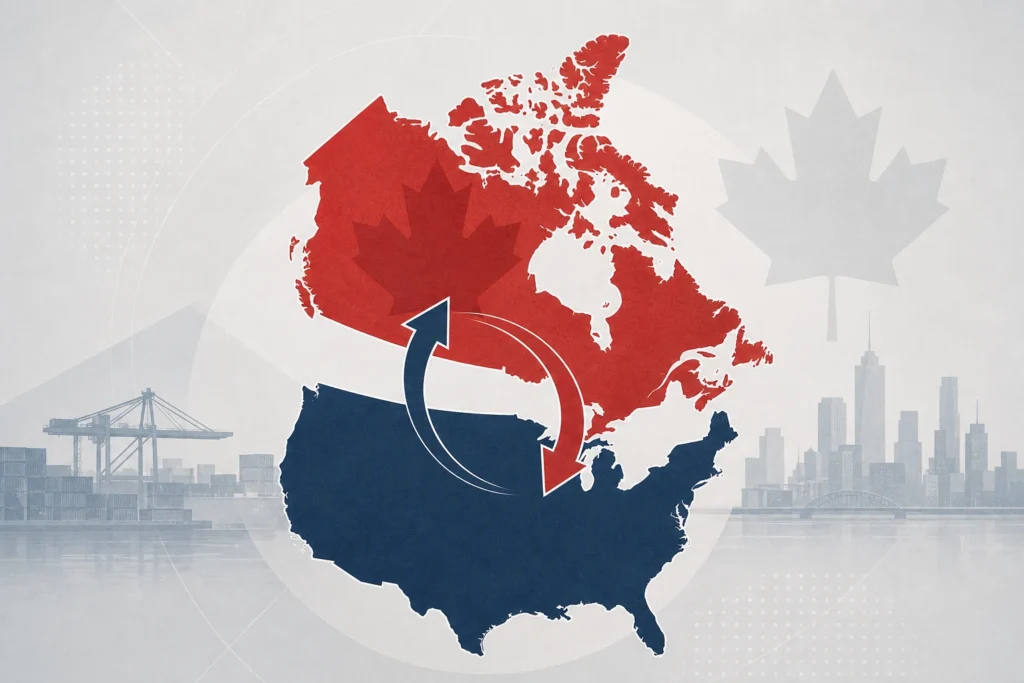
Canada U.S. trade tariffs are the dominant macro story for Canadian investors in 2026. Before you chase the next hot TSX stock, understand how cross-border rules, the CUSMA review, and sector duties can move earnings, dividends, and regional unemployment.

This essential guide explains Canada U.S. trade tariffs in plain language: what changed, which industries are exposed, and how households in Ontario, Quebec, and Western Canada can position portfolios without panic trading.
Related guides: TSX market trends Canada, Bank of Canada rate outlook, Canadian dividend ETFs for TFSA, Enbridge stock Canada, and RRSP vs TFSA.
Why Canada U.S. Trade Tariffs Matter More Than a Single Stock Pick
Canadian portfolios are not isolated from Washington policy. Roughly three-quarters of Canadian exports still flow south, and even companies that sell mostly in Canada often depend on U.S. suppliers, customers, or financing.
When Canada U.S. trade tariffs shift, the effects show up in:
- TSX earnings for autos, steel, aluminum, lumber, and manufacturing
- job markets in southwestern Ontario and parts of Quebec
- the Canadian dollar and inflation expectations tracked by the Bank of Canada
- dividend safety for exporters and industrial names
That is why many strategists treat the 2026 trade backdrop as a filter: first understand tariffs and CUSMA, then choose sectors and stocks.
CUSMA Review 2026: The Calendar Every Canadian Investor Should Watch
The Canada-United States-Mexico Agreement (CUSMA), also called USMCA, faces a formal review cycle in 2026. Negotiations may run past headline dates, but markets react to leaks, draft rules, and political speeches long before anything is signed.
Key questions for Canadian investors:
- Will rules of origin tighten for autos and auto parts?
- Will Washington raise the cost of non-compliance so fewer firms pay a low baseline tariff instead of meeting North American content rules?
- Can Ottawa trade concessions for relief on Section 232 sector tariffs?
Forecasters including Desjardins have argued Canada may keep broadly similar market access in 2026, with continued pressure only in sectors already targeted by U.S. law. That is a base case, not a guarantee. Treat CUSMA outcomes as a risk scenario for your portfolio, not background noise.
Section 232 Tariffs: Autos, Metals, and Manufacturing
Beyond headline threats, U.S. Section 232 duties on national-security grounds have hit steel, aluminum, autos, and related supply chains for years. In 2026, policy tweaks expanded how tariffs apply: in some cases the full value of a finished product faces a 25% charge, not only the metal content inside it.
That change matters for Quebec and Ontario manufacturers exporting assembled goods to the U.S. Federal aid packages for affected firms signal how serious Ottawa views the hit.
| Sector | Typical investor exposure | What to watch |
|---|---|---|
| Autos and parts | TSX suppliers, Ontario jobs | Rules of origin, plant announcements |
| Steel and aluminum | Producers, fabricators | Product-level vs metal-only tariffs |
| Energy and pipelines | ENB, CNQ, infrastructure | Less direct tariff risk, more macro oil |
| Financials | Big Six banks | Credit quality in trade-heavy regions |
| Consumer staples | Dollarama-style trade-down names | Domestic demand if exports weaken |
For energy infrastructure context, see Enbridge stock Canada. For broad TSX themes, read TSX market trends Canada.
Regional Impact: Ontario, Quebec, and the Rest of Canada
Canada U.S. trade tariffs are not felt evenly. Southwestern Ontario carries much of the auto and manufacturing exposure. Quebec exports a wide basket where a quarter of shipments may fall under sector-specific duties after recent rule changes. Western Canada feels more commodity and China-demand signals, though lumber and selected goods still face U.S. friction.
Unemployment in some trade-heavy Ontario corridors has run higher than the national average while other regions stay tight. For households, that split affects housing demand, consumer spending, and provincial budgets.
City-level cost guides: Toronto cost of living and Montreal earnings.
Portfolio Strategies When Tariff Headlines Dominate
Canadian investors cannot control trade negotiations, but they can control concentration and time horizon.
1. Diversify beyond one trade-sensitive sector
If your TSX holdings are heavy in autos, metals, or a single exporter, tariff headlines will whipsaw your net worth. Broad Canadian ETFs or a mix of banks, utilities, staples, and global names can reduce single-sector shock.
2. Separate trading noise from dividend fundamentals
Pipeline and utility models with contracted cash flow behave differently from pure manufacturers. Compare business models before selling into a headline.
3. Keep a cash buffer in competitive savings
Volatility often spikes around CUSMA deadlines. Emergency cash in a high-interest savings account Canada product lets you avoid forced selling.
4. Use registered accounts for long-term holdings
Tax-free growth in a TFSA or deferred tax in an RRSP does not remove trade risk, but it improves after-tax outcomes when you stay invested through a multi-year negotiation. See RRSP vs TFSA.
5. Avoid home-country bias overload
Some advisors argue that leaning 100% Canada ignores diversification benefits when U.S. policy is uncertain. Many Canadians hold U.S. ETFs inside registered accounts for global revenue exposure. Confirm withholding and account rules for your situation.
TFSA in 2026: Trade Risk and the $7,000 Contribution
The 2026 TFSA annual room remains $7,000. Media coverage often pairs that limit with stock ideas, but in 2026 the smarter first question is whether your sector bets assume a stable Canada-U.S. trade relationship.
Investors still add quality dividend names and infrastructure when rates are steady near 2.25% at the Bank of Canada. The difference is position size: trade-sensitive exporters may deserve smaller weights until CUSMA clarity improves.
Dividend ideas: Canadian dividend ETFs for TFSA. Platform comparison: best investing apps Canada.
FAQ: Canada U.S. Trade Tariffs and Investing
What are Canada U.S. trade tariffs in 2026?
They are U.S. import duties and related rules affecting Canadian goods, especially under Section 232 for sectors like steel, aluminum, and autos, plus ongoing CUSMA review uncertainty.
Will CUSMA end in 2026?
Full termination is a tail risk, not the base case in many forecasts. Investors should plan for continued negotiation, sector carve-outs, and headline volatility through the year.
Which TSX sectors are most exposed?
Autos and parts, metals, and manufacturing exporters face the most direct pressure. Banks react through credit and regional labour markets. Domestic consumer names may benefit if shoppers trade down.
Should I sell all Canadian stocks because of tariffs?
Usually no. Tariffs change relative winners and losers. Diversification, cash reserves, and a long horizon matter more than exiting the TSX entirely.
How does this connect to Bank of Canada policy?
Trade weakness can slow growth and influence rate cuts or holds, while tariff-driven inflation can complicate cuts. Read our Bank of Canada rate outlook for the rate side of the story.
Final Verdict
Canada U.S. trade tariffs are the main macro lens for Canadian investors in 2026 – ahead of any single stock story. Track the CUSMA review, understand Section 232 sectors, and stress-test your portfolio for Ontario and Quebec manufacturing risk.
Build around quality diversifiers, registered-account discipline, and cash you can deploy if volatility creates better entry points. That is how Canadians invest when trade policy, not earnings season, sets the tone.
Disclaimer: This article is for educational purposes only and is not personalized investment advice. Tariff rules change quickly; verify official government and brokerage sources before making decisions.